5 types of hooks that instantly make your social media posts more engaging

Kristo Olli
If your LinkedIn posts aren’t getting the reach you expect, here’s the hard truth:
Most people never make it past your first two lines. In fact, 9 out of 10 posts don’t get read beyond the hook – but the 1 that does? That’s where the results are.
And no, it’s not always the algorithm’s fault.
If you’ve ever thought: “Agh, my post was sooo valuable – why did it flop?” Then yes, maybe 2 out of 10 times the algorithm played its part. But the other 8 out of 10? It’s your hook.
When no one clicks “…see more”, the rest of your post simply doesn’t matter. That’s why I created this breakdown.
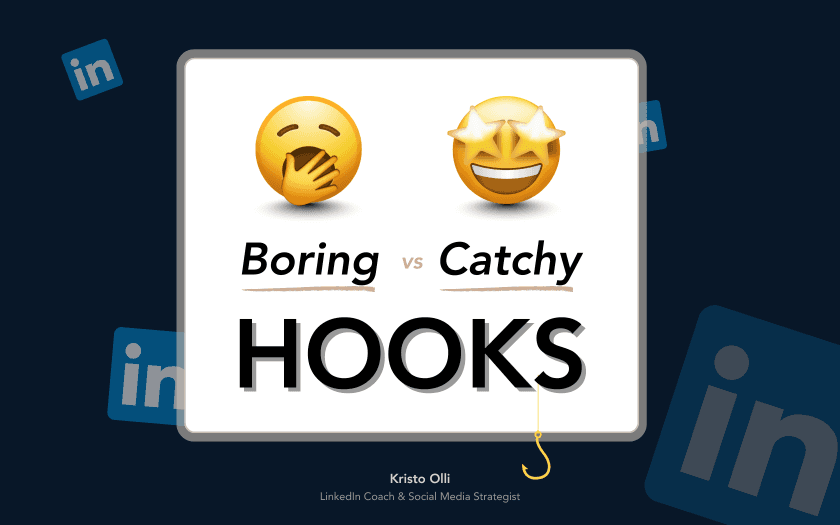
Inside, you’ll find 5 powerful hook styles that instantly grab attention, with real examples of:
❌ Boring hooks that get ignored
✅ Catchy hooks that make people click “…see more”
Small tweaks. Massive difference. Great ideas don’t go viral by accident. They go viral because the first line made someone stop.
Let’s get into it.
Why hooks matter more than ever
You could write the best post of your life. You could even be giving away a Lamborghini. But if your intro is boring, no one will ever find out.
Hooks either make or break your post.
Online readers are scanners. Your hook is the moment they decide:
“Keep scrolling?” or “Stop – this looks interesting.”
So let’s make sure they stop.
1. The Open Loop hook
Create curiosity by teasing missing information.
Boring hook:
“Today, I want to talk about what makes Instagram posts successful.”
Catchy hook:
“Most people ignore this IG feature – but it’s the key to 5x more engagement.”
Why it works:
Open loops trigger curiosity. You’re hinting at an insight… but not giving it away yet. This forces the reader to click “…see more” to close the loop.
2. The Data hook
Use numbers to create instant authority.
Boring hook:
“Let’s talk about lead nurturing.”
Catchy hook:
“80% of sales happen after the 5th follow-up… and most people stop at 2.”
Why it works:
People trust numbers. Data immediately positions you as someone who knows what they’re talking about. Even one statistic can transform your hook from “meh” to “tell me more.”
3. The Contrarian hook
Flip expectations. Challenge assumptions.
Boring hook:
“3 tips on how to hire top talent.”
Catchy hook:
“Stop hiring "rockstars." They’re probably ruining your team.”
Why it works:
Contrarian takes create tension. Tension creates curiosity. Curiosity creates engagement. You’re not being controversial for the sake of it – you’re introducing a fresh angle that breaks scrolling patterns.
4. The Story hook
Start with a moment, not a topic.
Boring hook:
“My journey of negotiating a higher salary.”
Catchy hook:
“I once negotiated a 42% raise without saying a single number – here’s how.”
Why it works:
Stories make you human. They build credibility and emotional connection. Readers sit up because stories feel like something happening, not something explained.
5. The “What If” hook
Help people rethink what they assume they know.
Boring hook:
“4 ways to scale your business.”
Catchy hook:
“What if doubling your revenue didn’t require a single new client?”
Why it works:
“What if” instantly invites imagination. It redirects the reader into a different perspective – yours. It’s simple, powerful, and works across industries.
How to choose which hook to use
Here’s a simple rule of thumb:
If your content teaches → use Data or Open Loop
If your content challenges norms → use Contrarian
If your content is personal → use Story
If your content is aspirational → use What If